www.evdokimos.com
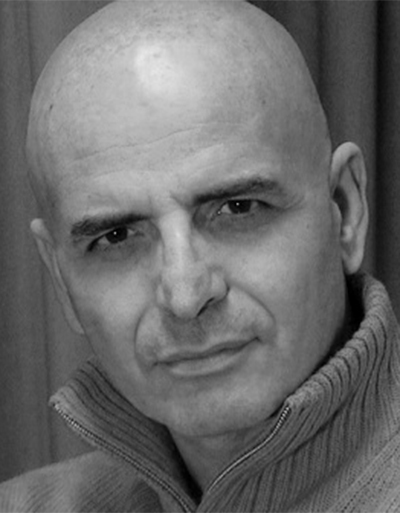
Born in Thessaloniki (1962). He graduated from the Ampelokipi Lyceum of Thessaloniki.
He studied at the Medical School of the University of Rome. He studied and graduated with distinction from the Drama School of the State Theatre of Northern Greece. He studied acting and directing at the HB Studio in New York on a scholarship from the American state (Fulbright Foundation). During this time he attended classes at the Actors Studio. He is a graduate of the European Culture department of the School of Humanities of the Hellenic Open University and of the postgraduate programme in theatre studies (Acting-Directing strand) of the School of Humanities and Social Sciences of the Open University of Cyprus. He is the first teacher of acting, directing and improvisation to give classes online (since 2016).
As an actor he has worked with the directors Andreas Voutsinas, Robert Sturua, Giannis Chouvardas, Pavlos Paganopoulos, Giorgos Kimoulis, Spyros Evangelatos, Stamatis Fasoulis, Diagoras Chronopoulos, Thomas Moschopoulos and others, and has taken part in many companies, among them KTHBE, the National Theatre, the Spyros Evangelatos Amphitheatre, the DIPETHE of Crete and Komotini, and the companies of Karezi-Kazakos, Aliki Vougiouklaki, Giorgos Kimoulis, Xenia Kalogeropoulou and others. He has taken part in film and television productions in Greece and abroad. He has directed productions in Greece and abroad.
In 1998 he founded “Theater of Changes” (http://www.toc.gr), where he is the Director of Operations, directs productions and teaches to this day.
He has taught regularly in Rome (International Acting School, Cinecitta), in London (Giles Foreman Acting School, Drama Classes London), and also in Stockholm (Kulturama), Istanbul (Müjdat Gezen Art Academy, S.A.K.M.), Tbilisi (Marjanishvili Theatre), New York (Theaterlab),
Paris (Ecole de théatre de Paris, Trixter), Amsterdam (Easylaughs group), Kathmandu (Dabali Theater), Izmir (Tiyatro Terminal), Bethlehem (Al-Harah Theatre), Zurich (PROVA.ZH), Milan (Civica Scuola di Teatro Paolo Grassi), Brussels (Nota Théâtrale Bruxelles), Copenhagen (Copenhagen International School of Performing Arts), Vladivostok (Improvl), and at various schools and theatre groups in Greece.
He has presented his work at International Theatre Festivals (Romania, Iran, Egypt, Tunisia, Kuwait, Mexico and others). He has taught in the theatre departments of the Universities of Alexandria and Cairo in Egypt, Tehran in Iran, Ciudad del Carmen in Mexico, Agadir in Morocco, Tunis in Tunisia and others. In the summer of 2016 he was invited to Santa Barbara, California, where he taught acting, directing and improvisation at the local university (UCSB) and staged Euripides’ “Helen” together with his two other productions, “Tonight We Improvise” and “Walking and Falling”. He was president of the jury of the International Theatre Festival in Agadir (Morocco 2007) and of the International Theatre Festival in Alexandria (Egypt 2019 and 2025). In 2025 he asked the festival organisers to establish a “Constantine Cavafy” award, a proposal that was unanimously accepted, and he presented the award himself in the events hall of the Library of Alexandria.
Since 2005 he has organised every year the ''In.F.o.Ma.T.'' (International Festival of Making Theater), an international meeting of theatre makers who hold theatre workshops, with participants from different parts of the world.
Six of his books have been published: ''Acting Without a Teacher'' (Η Υποκριτική άνευ Διδασκάλου), KOAN publications; the plays ''Athens - Moscow'' and ''Nothing'' (Τίποτα), DODONI publications; ''Improvisation in the Theatre'', EXANTAS publications; and ''Acting: From Theory to Practice'', ''To Whom It May Concern'' and ''7 Plays'', ION publications. His plays have been translated into Persian by Sakineh Arabnejad and published by Afraz, and have been staged in Tehran, directed by Katayun Feiz-Marandi, and in Zurich, directed by Anna Tsichli, while “Nothing” was translated into Turkish by Kemal Basar and published together with the theatre magazine “Yeni Tiyatro” in March 2010 and staged in Istanbul (2012) and Izmir (2013). “Athens-Moscow” was translated into Romanian by Radu Romaniuc and staged in Bucharest in 2012, directed by Adriana Zaharia, and in 2025, directed by Radu Catana. Both of his plays are performed at various university departments and theatres around the world.
He served as a member of the Board of the E.K.D.I.TH. (Hellenic Centre of the International Theatre Institute) from 2010 to 2014 and is a member of the Greek Actors’ Union (S.E.I.). He speaks English, Italian and French.
He has travelled to almost every corner of the planet, and in the summer of 2008 he went around the world in one month, leaving eastwards and returning from the west!
TECHNIQUE (ACTING)
Technique (acting technique) establishes the student’s acting identity and unlocks the mechanisms of their stage truth. In this class we do not embody specific roles but focus on the purely professional formation of the actor’s toolbox. Through a structured series of exercises, we do not “play” a character, but analyse and manage the fundamental states and circumstances faced by all the roles of the world repertoire, classical and contemporary. By training our reflexes and questioning our certainties, we learn to react with organic truth and psychophysical readiness to any role we may be called on to perform in the future.
ACTING (BEGINNERS - ADVANCED)
The class offers a structured path that links technique with practice, aiming at the professional development of the students as they learn, on the one hand, to develop their expressive means and, on the other, to deepen their craft of stage performance. The term begins with specialised exercises in concentration and activating the imagination, which prepare the actor’s body and psyche. In this way they develop the ability to respond with truth, dynamism and vitality to their fellow actors, as well as the ability to access sensory elements by using the power of imagination and the reserve of their memory. Through the acting method they are given, they gain a practical understanding of the terms: given circumstances, destination, inner and outer objective, intentions, obstacles and conflicts. At the same time they develop awareness of the power, function and dynamics of “place”, and learn to be in a state of discovery, which leads to action. Next, the exercises are applied in practice as the class moves on to the study, analysis and presentation of theatrical scenes and monologues from the world repertoire. Through this process, participants learn to analyse the text, discover the character’s motives and build true relationships on stage.
IMPROVISATION
In this improvisation (improv) class, designed for theatre students and young actors (18+) of every level and experience, participants unlock their potential and learn to react instantly on stage, using the power of improvisation as a strong tool for their professional development and acting practice. During a complete three-month term, the group will meet weekly for two hours (12 sessions in total) so that students can develop essential stage skills, such as learning to listen, adapting quickly to given circumstances, and having stage readiness and flexibility. Through group exercises, they learn to silence their inner critic, trust their instinct and turn unexpected mistakes on stage into innovative artistic choices. At the same time they develop tools of research and observation and become familiar with improvisation. They begin to assess themselves against professional standards and to cultivate habits of discipline and a strong work ethic. In this way they step out of their comfort zone, connect with a supportive group of peers and acquire a flexible toolbox to meet the demands of contemporary theatre.
HISTORY OF THEATRE – HISTORY OF THE ARTS – HISTORY OF HUMANITY I, II, III
I In this class, using world theatre as our starting point, which we will study from its birth to the present day, we will also have the chance to get to know the history of all the arts, in relation to the social, political and economic parameters of each era.
II and III Students who have attended I in a previous term and wish to enrol in the class again will complete assignments on the History of Theatre and Dramaturgy.
Students must be familiar with using a computer and accessing the internet.
All the classes are open to all.