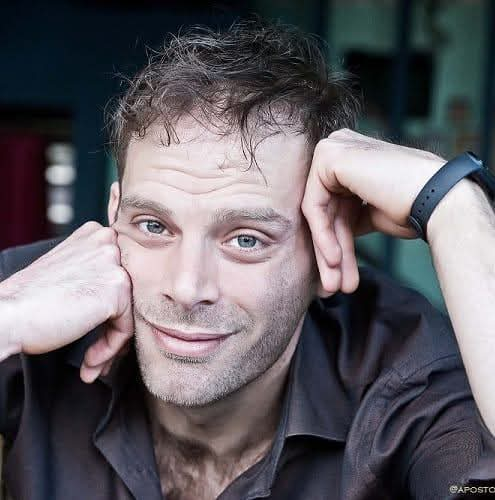
Omiros Poulakis is an actor, a graduate of the Drama School of the National Theatre (2004), and a final-year student in the Department of Theatre Studies at the National and Kapodistrian University of Athens.
He was recently accepted as a member of the European Network of Research and Documentation of Performances of Ancient Greek Drama (ArcNet).
In the theatre he has worked with leading Greek and international directors on plays from the world, ancient, classical and contemporary repertoire.
He was nominated for the Dimitris Horn Award for his performance in Not Quite Right by Ursula Rani Sarma (Καθόλου Καλά) and for an Athinorama Award for his performance in Orphans by Dennis Kelly.
In cinema he has appeared in, and played leading roles in, twelve feature films of Greek and international production.
He was nominated for the Film Academy performance award for his performance in the film The Milk.
He was nominated for Best Performance at the Raindance Film Festival in London for the role of Aris in the film I Don’t Want to Be Unpleasant but We Need to Talk About Something Very Serious.
In television he has played leading roles in standalone episodes (10th Commandment, 3rd Law, Inspector Bekas) and in the series Red River, the Sequel.
For the last five years he has been in charge of Innamorati, a theatre group of amateur actors.
ACTING
The aim and purpose of the class is to make us ever more aware of how deeply necessary it is to “disassemble” the established and enclosed vocal, physical and, more broadly, expressive patterns that the organic whole of an actor carries with them from the outset every time they face a role for the first time, or more broadly a stage challenge.
Are there tools and practices we can identify in our effort to become familiar with the sense of the unfamiliar?
Are there mechanisms through which we can activate our inner and outer material so that it comes to the surface and to the forefront of expression, as well as ways to handle it and organise it at a second stage in order to compose a role?
Could we perhaps become, with a speech and a body that are potentially theatrical as our foundation, those people we have always been and have never yet been?
The class is open to all.