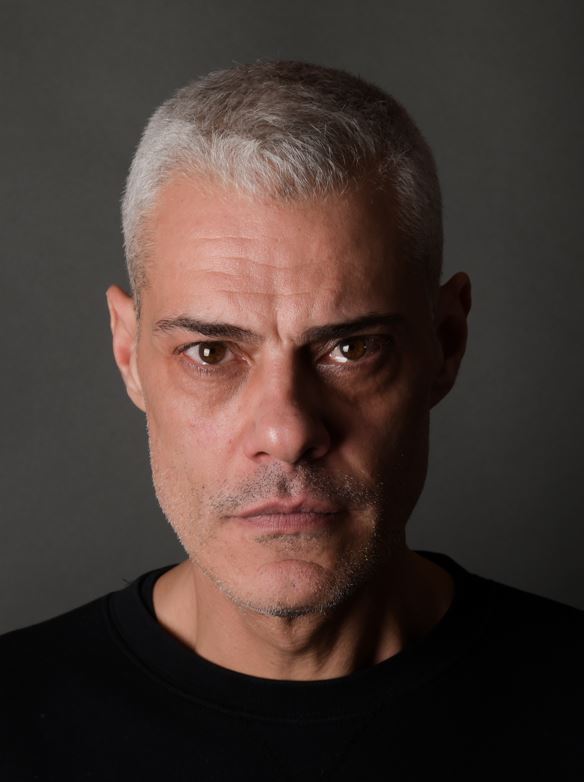
Spyros Steriadis was born in Corfu. He holds an MA in Acting (honours) from the University of East London. He is also a graduate of Queen Margaret University, where he studied Film Production & Direction (B.A. with merit) and Performing Arts (B.A. honours). He has also studied directing at IEK AKMI, acting at Vasilis Diamantopoulos' Theatre Workshop and at Theater of Changes, and journalism at the ANT1 School.
For five years he attended the movement systems of R. Laban – M. Graham with Dr Kiki Selioni, and worked with her as an assistant movement teacher at T. Chalkias' drama school "First Act" and at Mary Voyiatzi-Tragka's Higher School of Dramatic Art. As part of Dr Selioni's post-doctoral research, he directed Ibsen's "A Doll's House" (work in progress) at the Michael Cacoyannis Foundation.
He was among the founding members of the group "361 Degrees" (361 Μοίρες), with which he acted in and directed the productions: "My Heroes Die in Every Way Except by Gun", "Punishment" by K. Karafyllis, "Romeo and Juliet as a Fairy Tale" by W. Shakespeare and the one-act plays "Winter Day", "The Hottest Night of the Summer" and "Evening Walk" by K. Karafyllis. He has also taken part in the productions "Total Eclipse" by K. Karafyllis, directed by A. Sidiropoulou, and "My Heroes Die in Every Way Except by Gun" by K. Karafyllis, directed by A. Flourakis.
He worked with M. Bouziouri on "Hippodameia", documentary theatre at the Ancient Drama Workshop at the Philippi Festival, with N. Charalambous on "Ghosts and Fantasies", a composition of texts from ancient tragedy, with E. Tsolakidis on Shakespeare's "A Midsummer Night's Dream" as street theatre, with T. Sarantos on "Excerpts from the Libation Bearers" at the "days off youth theater" festival in Bosnia, and with the group "Negative Zero" (Μηδέν Αρνητικό) on "Twenty-Four Lies" by M. Karvounidou.
He has directed the short films "My Heroes" (shown at the 29th Drama Festival), "Klaus and Sonia" (shown at the 3rd Naoussa Festival) and "Red Line" (video art), and took part in I. Asmeniadou's short film "The Corridor" and in Yannis Ferchatis' documentary "Pause - Gate".
At the performing arts research centre Rectifier he presents the production "Mathieu" by Angeliki Spanou, in his own adaptation and direction.
ACTING - MOVEMENT
For an actor, rehearsals are identical with the exploration of their role. Only then can the actor stand on stage illuminating the action itself and nothing else. The first concern is the body, perhaps the strongest tool for an actor. The ability for intuitive understanding through the body is developed with exercises. The exercises help the actor to free themselves and discover what exists inside them, to listen within to movements they would never detect in any other way.
Through exercise the actor manages to activate their body and their resonators, and finally reaches a correct physical state. To achieve this aim, we will go on to the systematic carrying out of physical and vocal exercises. Technical practice is necessary to free our body from everyday habits and to achieve conscious control of it.
Peter Brook says that animals move with grace because their bodies are free of any tension, without however being completely relaxed. "Their body is free and balanced and their spirit conscious and specific", he notes, and this must be the basic stance of the actor on stage. The actor is a sensitive instrument whose inner vibration is externalised and then perceived by the audience. A central requirement, then, is the passing of this vibration through the whole body, which is achieved with exercise.
Through the process of learning the tools, we will understand that the slightest detail within a movement must serve our purpose. In other words, we must put it under the microscope of our attention and observe it.
Isolation is a tool that helps actors express their inner dialogue through the plasticity of their movements. It is a tool that helps in awareness of the mechanics of the body and in breaking down every movement into the components "intention"-"action"-"reaction". By choosing the point of isolation each time, the physical action changes and a completely new form is produced. This development is not the product of a cerebral choice.
Observation is also a tool that helps us understand the physical path a body travels. Obviously simply copying a person's external movement is not enough, but through observing the isolations that a person unconsciously chooses, we can perceive the emotional path they travel.
Rhythms are another important tool for the actor's work. Exploring our rhythms leads us to building the role from the outside in, with physical actions. Working with a real rhythm that is in agreement with the action favours the spontaneous emergence of sincere feelings. Rhythms give us the possibility of keeping a freshness and a natural variety in our work.
The aim of using the tools is to connect the physical function with the emotional function of each moment. Only by having found all the physical and emotional forms is the actor able to connect and create a kind of map of their energetic and emotional journey.
Students may choose any play they like. They are asked to come in sportswear.
The class is open to everyone.