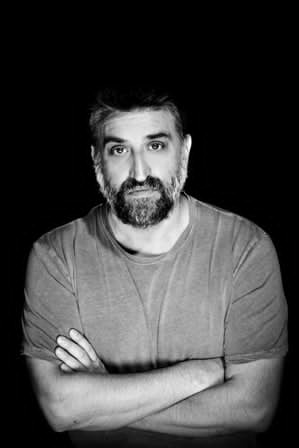
Giorgos Chouliaras is a Director, Actor, Acting Teacher, Theatre Scholar-Theatre Educator & Researcher of Theatre Practice. He holds a BA in Acting (Acting Certificate 2003) – M.V.T. Drama School, a Master of Fine Arts in Theatre Practice (with distinction, 2011) and a Master of Philosophy in Performance Practice Research (2016) – University of Exeter, a degree from the Department of Theatre Studies of the School of Fine Arts of the University of the Peloponnese (with distinction, 2026), and English and Greek Pedagogical & Teaching Qualifications (LTHE/Learning and Teaching in Higher Education – University of Exeter and P.E.E./Pedagogical & Teaching Competence – University of the Peloponnese).
Along the way he distinguished himself at the HYPERION International Festival with two First Awards for Best Actor from UNESCO and the HYPERION Foundation (2002), ranked 1st nationwide in the State Scholarships Foundation (I.K.Y.) examinations for postgraduate studies abroad (2009), taught in England and at the Drama School of the University of Exeter as a Graduate Teaching Associate (2013-2014), was a member of the first Greek participation in the Chekhov Festival in Moscow (2017) and ranked 1st in the transfer examinations of the Department of Theatre Studies of the School of Fine Arts at the University of the Peloponnese (2022).
He has practised acting since 2001, directed since 2009 and taught since 2013 at universities, drama schools, municipalities, theatre workshops and groups, having worked with a host of actors and directors in Greece and abroad (Phillip Zarrilli, Howard Barker, Alison Hodge, Martin Harvey, Ian Morgan and others). Finally, he has taken part from time to time in various distinguished international and domestic film and television productions.
ACTING - IMPROVISATION
This class deals with the approach to the individual and collective function of the actor in contemporary theatre, through the combined practice of contemporary acting techniques in 5 stages:
The 1st stage examines the participant's existence on stage as a unit: getting to know each other, exposure, presence, discoveries, participation, familiarity, trust.
The 2nd stage examines the student's relationship and work with the text: personal connection, analysis, construction-deconstruction, delivery, address.
The 3rd stage examines the contemporary approach, interpretation and application of the Stanislavsky system, both by Stanislavsky himself and in later interpretations of it, through intellectual, experiential and psychophysical work (psychophysical theatre).
The 4th stage examines the interpretation of an important part of the Polish theatre tradition Grotowski – Gardzienice – Song of the Goat through organic, psychophysical and physical approaches (physical theatre).
The 5th and final stage concerns the management and application of the material and tools taught, with the aim of creating an artistic work.
*At every stage there is work with Improvisation, with and without text.
The class is open to everyone